

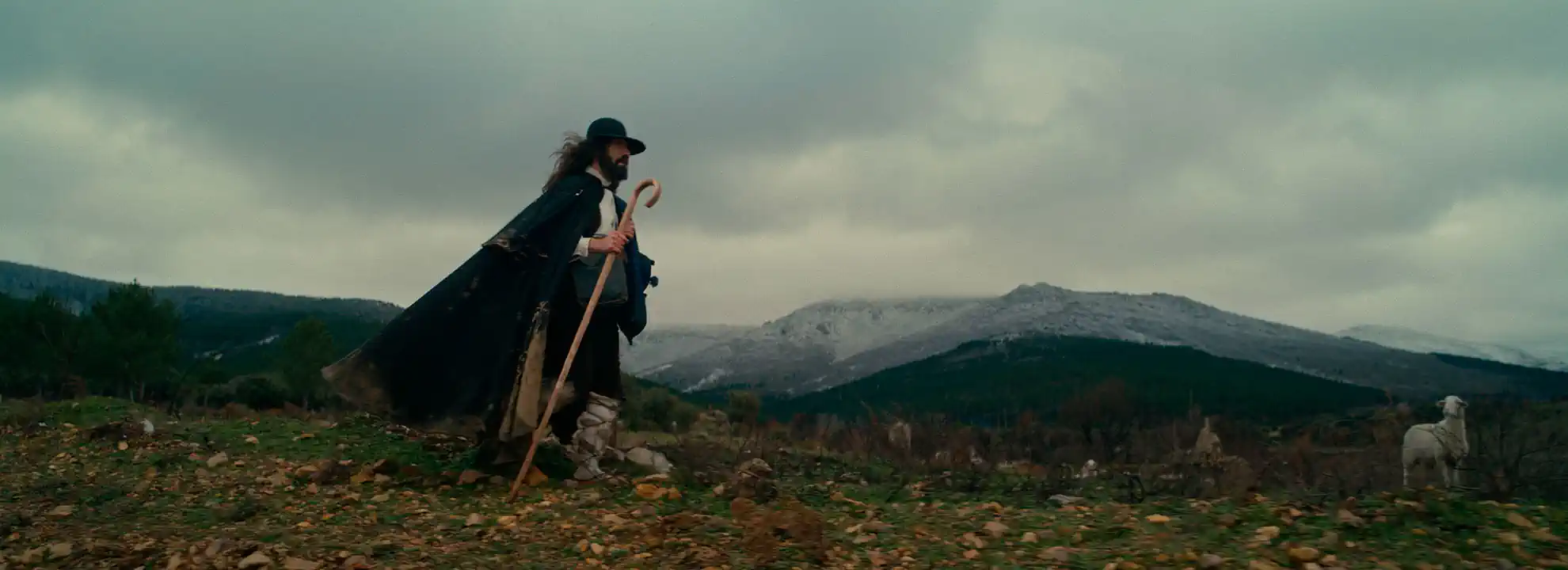
Apartamentos Rurales Braña La Code is collaborating in the presentation and subsequent discussion of Pastoris in Somiedo, a film that finds in transhumance a powerful link between territories, landscapes, and cultures.
Some paths do more than lead from one place to another. For centuries, transhumant routes were also channels of exchange. Flocks travelled along them, but so did people, knowledge, customs, stories, and words.
Transhumance was a way of relating to the land and of building a shared culture among communities separated by mountains, valleys, and hundreds of miles.
This cultural heritage once again takes center stage in Somiedo with the presentation of Pastoris, a film by Pablo Moreno that brings pastoral life and the ancient transhumant routes between Salamanca and Extremadura back into focus.
The event, supported by Apartamentos Rurales Braña La Code, also forms part of the XVI Lagos de Saliencia Transhumance Pilgrimage, a celebration that keeps alive the memory of those who made mountains, brañas, and livestock routes an essential part of their way of life.
Transhumance as a Meeting Point
To talk about transhumance is to talk about livestock and pasture, but also about a way of understanding the world.
The seasonal movement of flocks required an intimate knowledge of the landscape, the ability to read the weather, familiarity with the routes, and command of a body of knowledge passed down from one generation to the next.
In Somiedo, this culture is closely tied to the brañas, cattle-herding life, and a relationship with the mountains based on understanding and making careful use of the territory’s resources.
The brañas were not simply places where people and animals stayed. They were places of work, communal life, and knowledge-sharing—settings in which a distinctive culture gradually took shape.
Pastoral cultures, however, were never confined by administrative borders.
For generations, the movement of flocks encouraged contact between distant communities. Shepherds and livestock farmers shared routes and experiences, exchanging ways of working, customs, music, stories, and different ways of naming the world around them.
Transhumance can therefore also be understood as a vast cultural corridor: a network of human relationships that connected territories and left its mark both on the landscape and on the memory of its inhabitants.
When Words Travel Too
Language holds a particularly significant place within this shared heritage.
Each pastoral territory developed its own ways of naming the landscape, animals, tasks, tools, weather phenomena, and relationships between people. Words born from everyday experience preserve an essential part of the memory of those who used them.
In this context, the encounter proposed by Pastoris takes on a particularly compelling dimension. The film brings different territories with pastoral traditions into dialogue, along with their respective forms of expression. The speech of Somiedo, fala from Extremadura, and palra d’El Rebollar are all part of a broader rural linguistic heritage that offers insight into a particular way of interpreting and inhabiting the world.
This linguistic dimension gives Pastoris an exceptional value. The film was shot entirely in palra d’El Rebollar, a variety within the Astur-Leonese language group spoken in southern Salamanca and northern Cáceres and now at risk of disappearing.
Language is therefore not merely a cinematic device. It forms part of the characters’ identity and of the cultural world the film seeks to preserve.
This attention to language is especially relevant at a time when many of these forms of expression are at risk of disappearing alongside the social contexts in which they were once used.
When a word disappears, it is not only a term that is lost. A way of observing, classifying, and understanding the land may disappear with it.
Pastoris: A Story of Shepherds and Return
Pablo Moreno’s film is set at the beginning of the nineteenth century, during the Peninsular War.
Its protagonist, Domingo, returns home after being presumed dead in the war. The world he comes back to has changed, and he must find his place in it once again.
An opportunity to earn a living as a shepherd leads him on a long journey with a flock of sheep from Salamanca to the pastures of Extremadura. The route along the old transhumant paths is shaped by the hardships of the journey—and by the dangers of a natural world that still held a powerful presence—but also by the protagonist’s memories and inner conflicts.
Transhumance thus becomes much more than the film’s historical backdrop. The flock’s journey mirrors Domingo’s inner journey as he confronts his past and rebuilds his relationship with his family, his community, and himself.
The film also pays close attention to the elements that shaped that pastoral society: its landscapes, clothing, songs, dances, traditional instruments, and customs.
At times, the result resembles an authentic record of ethnographic memory, recovering aspects of a rural culture that are now steadily disappearing.
A Living Memory
The presentation of Pastoris in Somiedo therefore means more than simply screening a film. It opens a space for conversation about what still survives in the memory of pastoral territories and about everything that is at risk of being lost.
The XVI Lagos de Saliencia Transhumance Pilgrimage embodies precisely this desire to keep a legacy alive.
To remember the shepherds and their flocks is also to remember those who made possible a way of life closely bound to the mountains, the brañas, and the livestock routes. It means recognizing the knowledge accumulated over generations and the culture that emerged from that everyday relationship with the land.
It also means recognizing that rural heritage consists of more than buildings, landscapes, and paths. It is made up of people, words, gestures, trades, songs, stories, customs, and knowledge—seemingly small elements that, together, shape a community’s identity.
Preserving pastoral memory, then, does not mean looking only to the past. It means understanding the value of a culture that still forms part of the identity of our villages and landscapes.
It means listening to those who still remember how people lived, worked, and spoke. And it means understanding that when the practices, words, and people who sustain them disappear, an irreplaceable part of our history disappears with them.
In this sense, Pastoris and the transhumant tradition meet on the same path: preserving memory so that it can continue to live as culture. It is a path that connects Salamanca and Extremadura with the mountains of Somiedo and reminds us that, for centuries, shepherds did more than move their flocks from one pasture to another. They also carried with them a way of living, relating to others, and naming the world.